

Kate Stapleton is an award-winning filmmaker, musician, and advocate for birthmothers within the adoption community. As the harpist in The Stapletons, she has spent years performing across the country with her husband, Casey Stapleton. Her passion for storytelling and advocating for birth mothers led her to create The Inner Sea, her first feature film, which offers rare glimpse into the adoption experience through the eyes of a birthmother. Kate's work blends personal experience with artistic expression, creating a platform for adoption-related stories that have long been underrepresented in the media, and this week we had the opportunity to learn more.
Is this your first film?
So very much my first film! I had zero experience with film – none at all – and I wasn't planning on making one. I'm a storyteller; I'm a writer, and I'm a musician. Our music has always been song and story, and those are very interwoven together in the way that we communicate through music. I always dive into the history of the projects that I'm working on, to pull in a storytelling aspect. I've done a lot of theater. I ran a Shakespeare Company, and I’ve directed live theater, but I was raised with no television. Film is another storytelling medium, but it's not one that I had previously considered. I don't really watch television, and I'm not a movie watcher in general, but I've loved working with film because I think it's a really powerful medium for storytelling. There's a lot of vitality around it.
So you just decided to do it and went for it? That's gutsy and really bold. We love that!
I think it ties into birth parents and the vulnerability of your own story. I was writing about adoption because I'm a writer, and so that was one of the ways that I processed it. So I was already writing about adoption, but my husband was a teacher. He was a high school teacher for 17 years, and we had watched a documentary together one night, and he turned to me and said, I think you need to do this. I think you need to tell your story in a documentary form. Because as a teacher, he knew there was nothing out there by a birthparent, telling that side of adoption. We’ve watched documentaries by adopted people, and there are stories told all the time from adoptive families, but whenever he taught anything about adoption, he found that the birthparent perspective is completely lacking, like it doesn't exist. He said, you have the ability to tell your story, and so you should consider doing that. That was really the genesis of this project.
We were working with a cinematographer to do footage for a musical project: we were taking this 40 foot long, bright blue school bus along the coast of the Great Lakes, and the footage was so beautiful, like, just crazy, stunningly beautiful, but my husband and I have 6 kids, and he’s driving the bus and I’m nursing a baby, and we’re playing shows while being the cooks, and nannies, and the roadies. We were doing everything, and there was no way we could add another project into the mix, so I approached the cinematographer and said we had this idea for an adoption documentary, and when he called me back, he said he was really drawn to it, and the idea that grief, and beauty, and art, and suffering, were all interwoven. It wasn’t necessarily my plan to make a film when I reached out – it was a PS on an email, the idea of it – but he was all in.
I knew nothing about filmmaking. I had to sit down with him and ask, what is a director? What is a producer? What does a producer do on a film? What does the cinematographer do? I had to understand it, because it was really important for me to be the one telling my story. Because so often birthparent’s stories, if they are told, which is rare, are told by other people. I needed to produce the film, and I needed to direct the film, so if that meant learning how to direct a film, then I just was going to learn how to direct a film.
“I was just going to learn how to direct a film.” You make it sound so easy!
I mean, it's storytelling, which I’ve been doing forever, and I brought in an excellent editor, who is also an adoptive parent. The first thing that we ever shot for the film was the footage of my birth daughter's family in California, because I felt like, if I was going to tell her the story, I needed to root her in her life, to honestly represent her life. So the first thing we did was send the cinematographer to California to get that footage, and it followed in the editing process that we naturally had a Part One, Part Two and Part Three. Part One introduces me and my story, and as a musician, and with my family. Part Two was her life, and her story as a musician, and her family, and the night we finished Part One, which ends with the last pictures of my daughter and I together in the hospital, my editor got a call from the hospital that he was about to become an adoptive father. We had to pause the whole film-making process for three months, because he was the primary caretaker and was going through the whole experience of parenting. The timing was just was wild, and I think we learned a lot from each other, but it was super important for me because I realized that, as a woman, as a birthparent, I had to be the one who was able to have agency in telling my story.
That’s why we started Activism in Adoption – to platform birthparents and adopted people so that they could tell their own stories, instead of having their stories told by other people, because so often it is adoptive parents and adoption professionals speaking for them, and creating versions of their stories that aren’t recognizable to them.
There's no story of adoption; there are only adoption stories. So in every adoption, you have all these completely different angles that are all totally true. I can tell my piece, but my daughter's had a different experience. Her parents have had a different experience. And I think there are very understandable reasons you don't hear birth parents stories: you don't make the decision to place a child for adoption unless there is an extraordinary lack of resources in your life – which end up cascading lacks. You have a lack of support, a lack of resources, a lack of money, a lack of education, a lack of sobriety, a lack of sanity. There was one woman in Upper Michigan that I met at a film festival while presenting my film who was lacking a leg. She had two young boys. She lost her leg in a car accident, and she was pregnant, and she was like, I cannot raise a third son with one leg. And so you come from this place of lack, and then that's compounded by the grief of adoption, right? So you've now placed a child for adoption, which is not something that's going to inspire you to fix any of those problems quickly. It often pulls you down more deeply.
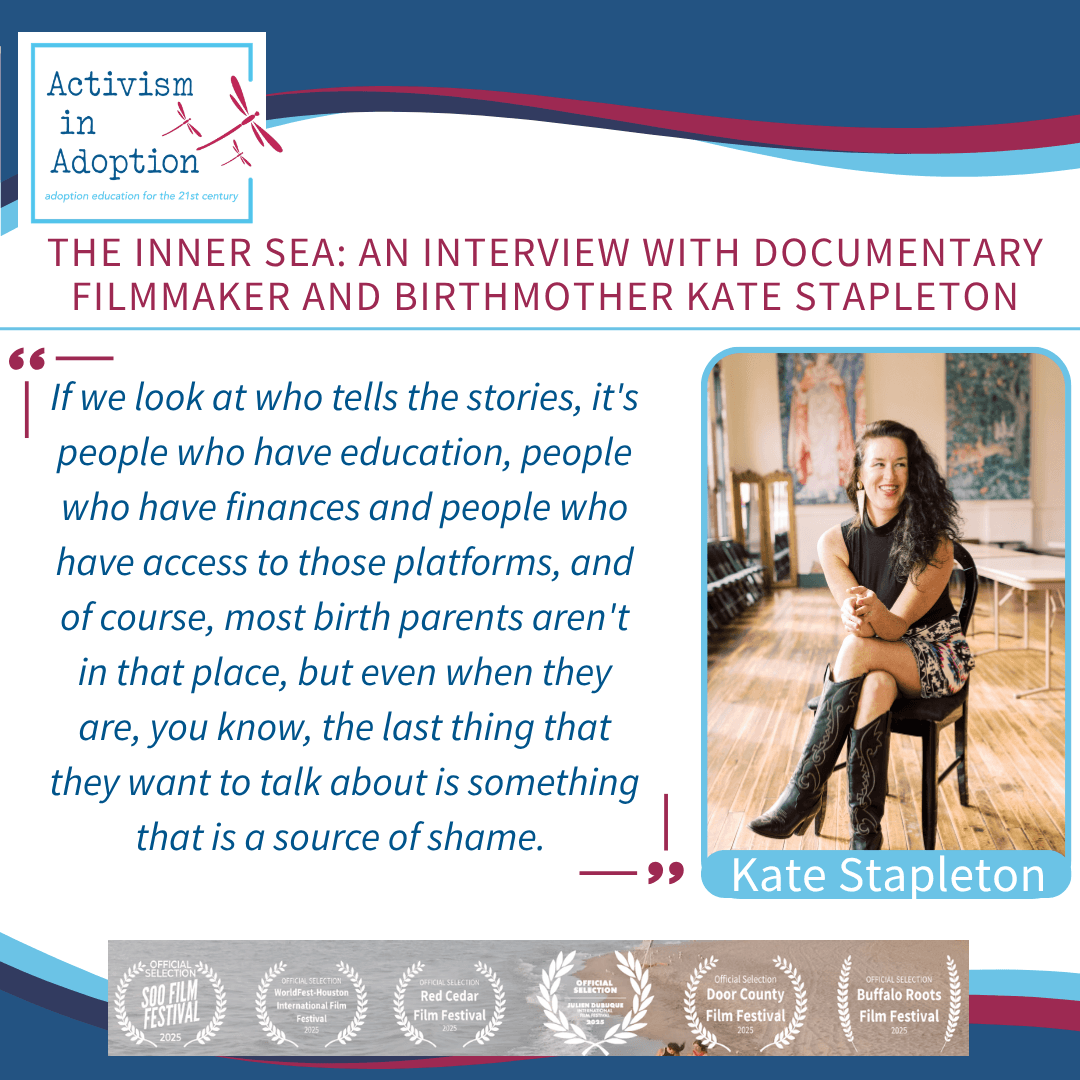
If we look at who tells the stories, it's people who have education, people who have finances and people who have access to those platforms, and of course, most birth parents aren't in that place, but even when they are, you know, the last thing that they want to talk about is something that is a source of shame. Culturally, we have a Vietnam vet approach to birth parents, right, where we say things like, oh, congratulations. Great work. The framework of PTSD was invented to talk about this dichotomy of what happened to Vietnam vets returning, right, and how what they experienced wasn’t be acknowledged in any way. It makes sense that that happens to birth parents too. Even if they are in a place where they're able to talk about their adoption story, it's hard to do. It brings up a lot of really painful feelings. But you know, for me, it also was a real avenue towards healing.
What was the most challenging aspect to you to make this film?
I have one daughter that I placed for adoption. I have six children with my husband, that we parent. And at the top of my notes as I was working on the film, while I was working through the scenes and the structure, at the very top was, as a mother, how do I make this movie without ruining my children's lives?
Imagine being 13 years old, and your mother is about to set off around the world, talking about how she got pregnant when she was 21? That is potentially such an embarrassing and horrible side hobby for your parent to take up. I didn't want it to feel like that. It's a complicated thing to navigate. I wanted to make it a story about music, a story that was more universal, and also to represent myself and my family and my daughter and her family as all being whole. She agreed to be a part of it, which was really gracious of her, but I'm telling my story in this documentary and not hers, and she would have a totally different version of it. When I was directing her storyline, she was at this incredibly vulnerable moment of developing as an extraordinary musician; she's really, really extraordinarily talented. She was writing songs, starting a band, totally on fire, falling in love with music, and we captured all that in this incredibly raw way.
I wanted my approach towards her to be her story as an artist, and her development as a young artist, because being adopted is not your identity. It's not a choice you've made for yourself, right? I don't – or can't – speak to how that affects her identity. That was something that was really important to me, you know, representing my kids and their lives and as broader than this one thing. That was something that I had a lot of back and forth with, with the editor, because he would say, we got to cut to the chase. He kept saying, this is the first documentary I've ever seen that doesn't start with when I was 21 I got pregnant, and I fought super hard on that, because that's a piece of my story, but I need to establish myself in my film as a woman and an artist and a mother and all of these other things that are very important in my life. I want to be seen as, as a whole person. I think it's easy to just be defined entirely by your choices.
Did anything surprise you, or did anything change for you in the process of making this film?
At the very beginning of filming, I was talking about grief with my cinematographer, and he looked at me and said, So, how did you survive this? And I replied, I don't know if I did. I didn't feel like I could answer that question by saying that I had survived it, you know. There's a quarter century now of this story, but communicating through art, in a lot of different mediums, I guess that's been a great tool of healing for me. Writing it out allowed me to question my own story, and it shifted my understanding of the story, and some of the narratives that I was telling myself. Writing showed me how adoption is a complex wound, and it's a wound that is profoundly cyclical. It will always come back and strike you in the heart when you least expect it. But I think I have a much better understanding of how, I live with grief and love and beauty in adoption, through the work of examining my own story.
What does the title "The Inner Sea" mean?
There are multiple levels of meaning to it. First, there is the physical, external ‘inner sea’. The Great Lakes are almost 25% of the fresh water in the world, and a body of water doesn’t have to be a salt sea to be a sea. The Great Lakes are extraordinary; like you're standing on the shoreline of a sea. At the time I had this folk project happening, where we were performing sea songs and shanties of the sailing era on the Great Lakes in all these little beach towns along Lake Michigan, and seeing all this incredible beauty on the different lakes and throughout the summer.
While we were doing that, I was in the process of reunion. I've always had an open adoption, but my daughter grew up on the other side of the country, and then she came to college about an hour from where I live now. Because of it, her relationship with our family changed dramatically, because we used to only see each other once every couple of years, and we had never had this kind of proximity before.
All of a sudden she was spending holidays with us, and staying in a room in our house, and it was very different and amazing, but also really challenging. For lots of reasons I didn't understand at the time, it brought back the intensity of my early emotions about placement in a totally unexpected way, but when I decided to place my daughter, I was living in Chicago, on the shores of the Great Lakes, and then right after I placed her, I stayed with my grandmother along Lake Michigan, and every night I would walk down to the shore of the lake, and think, this lake is so beautiful, this sorrow is drowning me. I don't know if I will survive. The physical beauty of the Great Lakes was like this beacon that made me feel like, maybe there might be some hope in the world. Fast forward 21 years, and my daughter was house-sitting for us while we were on tour. I remember we had just gotten to the first stop on the Great Lakes, which was Erie, and we pulled into a campsite, and I rode down to the water by myself, and when I got down there, I got this text message from my daughter that said, everything's fine, everything's great, your chickens are doing well. I'm so proud of you. I hope you have an amazing tour. And I realized I'm physically standing on the opposite side of an inner sea, like my relationship. I could never have imagined that 21 years ago.
I was also thinking a lot about the internal inner sea. You know, the womb is an inner sea, right? We are all formed in the waters of an inner sea. And I think that people often don't contemplate the time that birthparents spend with their children while they're pregnant. So this sense of the womb, the inner sea as a physical reality, the inner sea as the womb.
You're a musician, you're a filmmaker, you're a writer; you're living a gloriously creative life. Do you have any advice for people on how to build that into their own life?
I think it's really easy to not engage in art. We have a pretty deeply anti-art society. We have this mentality where everybody wants to consume other people’s art all day long, but if you actually want to engage in creating it, it's like, well, that's for another time. We're going to prioritize everything else first. I feel like I've had so many different forms of art be super powerful and healing in my life, whether it was dance or theater or music. You know, it takes work to create space for making art, but I think it's incredibly worth it. If you look for it there's so many opportunities but to do that you have to disregard this very strong message that kids who are interested in art are consistently told: Oh, that's great that you like making art, but it's really important that you go to college for something else that's not art, and figure out a way that you can support yourself responsibly. And then, if you're you know, then you can do art, like, a few hours a week in your spare time. And if you're super lucky, I'll come out and maybe give you, like, $1, because it's so great that you got to engage in your passions.
You have to learn how to disregard a lot of really intense messaging about the lack of importance of art in our lives. You're gonna have to buck the trend a little bit, you know? I think it's really important not to lose the things that that heal us and make us whole, whether that's walking down to the beach or writing a poem or playing a song. And I think there's also a real sense that we shouldn’t do anything if we aren’t an expert in it. Like, if it's not going to be good, it's not worth doing. And you can't get good at anything without doing it badly, so you should just start – or restart. If it was something you were doing in middle school or high school or in your 20s, you know it's definitely possible. It takes work, but it's possible.
We heard you also wrote a memoir?
I did. The deal was just announced, which is really wild. It's also called The Inner Sea, and it begins and ends on the Great Lakes. It's an adoption memoir, and the focus is different than the film, just because they're different mediums. But, you know, I was writing all through my pregnancy, and I was able to pull all of my journals and writing over the years. I'm so glad I had them, but I'm also glad I had that distance and space to do it, and it was, it was just an amazing gift to spend the time writing it, and I'm excited to share it with the world that comes out in March 2027, so in advance of Mother's Day. It's a memoir of motherhood, adoption and a bright blue bus.
Registration is currently open to screen The Inner Sea, and join us for a conversation with Kate. The Inner Sea film debuted in 2025 at the prestigious Julien Dubuque International Film Festival, won Best Film at the Lake Effect Film Festival. and Best New Filmmaker at the Fresh Coast Film Festival in Marquette, MI.
The film has also won laurels at the Door County Film Fest, the Buffalo Roots Film Festival in Rome, the Red Cedar Film Festival, Houston International Film Festival, Soo City Film Festival, and the Saugatuck Film Festival.
To learn more about Kate, visit her website, or find her on Facebook, Instagram, YouTube, iTunes, and Spotify. Her Book, The Inner Sea, is slated for release in March 2027.