

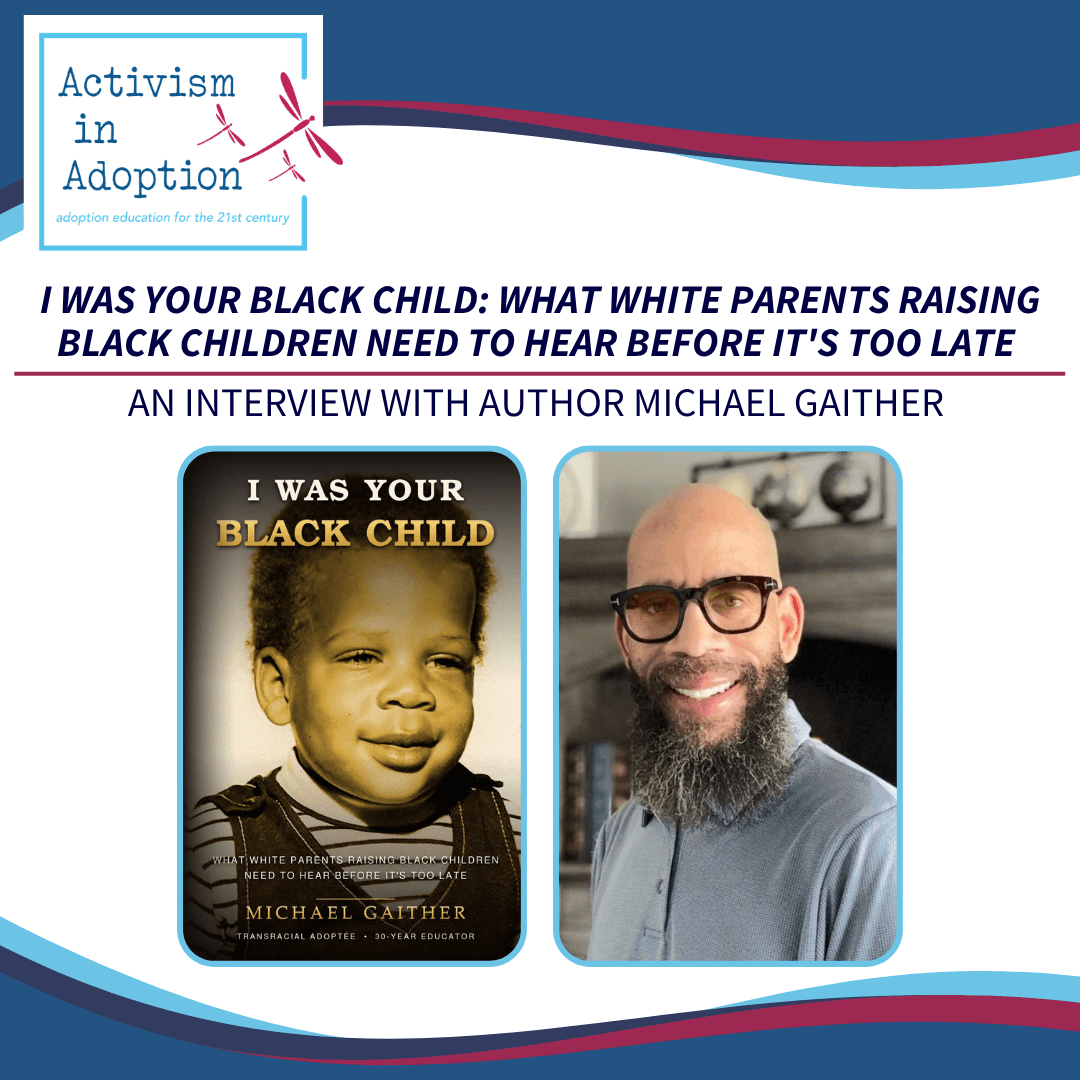
Micheal Gaither was adopted at eighteen months old and raised by a white family in Lincoln, Nebraska, and throughout most of his childhood he was the only Black person in every room he entered. Michael is a 30 year veteran of public education, working first as a teacher, and then a principal, then transitioning to executive leadership coaching for educators, and he brings that educational expertise to his recently released book, I Was Your Black Child, What White Parents Raising Black Children Need to Hear Before It's Too Late, which tells the story of his life as the catalyst for helping white adoptive parents reframe how they understand transracial adoption, providing them the tools they need to show up for their children.
Let’s start with the basics: who are you, and what is your connection to adoption?
My name is Michael Gaither, and I'm a transracial adoptee who was born in Syracuse, New York, in 1972, and adopted into a white family in Lincoln, Nebraska, after spending 18 months in foster care in Syracuse.
Your new book, I Was Your Black Child, What White Parents Raising Black Children Need to Hear Before It's Too Late has a very unique structure to it: part memoir, part parenting manual, and part workbook of sorts, featuring prompts encouraging parents to reframe their understanding of the realities of transracial adoption in order to best support their children. What made you decide to write it this way?
As I was thinking about writing a book, I realized that I could have just told my story, and I think people can learn something from it. But as I had interactions with adoptive parents and interactions with other adoptees, I found it important to make sure that there was something that parents could take away from it. It's one thing to hear my story, but my story just fits me, right? That doesn't mean it matches everything that adopted families are going through, so I wanted to take everything that I talked about in my own story to turn it back to families that are reading the book so they can say, Oh yeah, that's how I can think about this particular issue. It's not exactly like that in my family, but I remember when my child said something similar. I remember when my child came home and was sitting with this issue Michael wrote about.
In your book, you say, “knowing where your child came from is one thing, and what they walk into every day is another.” Can you unpack that for us?
I was thinking about my own parents. We talk a lot in adoption about how parents love their children, right? We know that. But I lived in a white family, and I’m Black. Obviously, there is going to be attention on our family because of that. My parents can know where I came from, but what they didn’t know is what was happening when I left the house every day, what I was walking into, and that was kind of the disconnect in my own household. Plus, parents work, but while they are raising kids, that's also the time where they are in the prime of their career. They're busy. My dad was a minister. My mom had a background in social work. They were busy, and I was going to school, and for a lot of kids, they are only seeing their parents for a couple of hours in the evening, and it’s very easy for parents to miss what their child may be going through.
And something to know about adoptees is that sometimes, when we come home, we don't want to disrupt the culture in the household. In my household, my dad would look tired when he got home, and he needed to relax. He needed to chill. My mom came home and she would be cooking dinner. Me bringing my troubles home and wanting to discuss it? I learned early what kinds of conversations would change the mood, the air in the room, and I could tell if they didn’t feel comfortable, or felt like maybe they didn't have the answer, and instead of bringing anything up, I’d tuck it away because I didn’t want to be the reason the household wasn’t at peace.
I grew up in Lincoln, Nebraska, and it’s mostly white: all white neighborhoods, all white schools, all white church, and coming home, even though those were my parents, I'm still talking to white people. For me to bring home what I was going through in terms of being teased and not really having a place where I necessarily fit was still me talking to white people.
I don't truly believe that my parents understood the misery that I was in when I was leaving the house because the love that's in the house doesn't follow you when you go off to school. It doesn't follow you down the street. I'm protected at home because I'm surrounded by people, white or not, that love me. I love them. However, when I leave, that protection, that visual, doesn't follow me. Now I'm just a Black kid walking down the street. I’m not placing blame on my parents, for not knowing how hard that transition was for me, leaving the house and going out in the world. I wasn't uncomfortable in my house. That's the only family I knew. But when I walked out the door? Now people have questions.
People wanted me to explain my family. And when I was really young, I just didn't have the words to do it. All I had was, that's my mom. That's my dad. That's my sister. That's my brother. That's all I know. They're all white. I’m Black. I knew there's this word adoption, but when I was in elementary school, I couldn’t explain it.
Throughout the book, the theme of being conspicuous keeps coming back, and you really summed it up well when you wrote, “as a Black man, I feel like I'm on stage almost everywhere I go outside my own house. I watch how I talk and how I walk into a room. I’m careful about what type of music I play in my own neighborhood. And I try to be extra polite in stores, so somebody knows there are good Black men in the world.”
When I was a kid, I remember looking in the mirror trying to figure out who I was, because I was different. I couldn’t go to school and just blend in; it just doesn't happen that way. I think that feeling of being on stage, it follows me to this day. Everywhere I go, I feel like I have to present myself a certain way.
I live in The Villages, Florida, which is 98 percent white people. You know, I love it. People ask me all the time, why'd you want to come here? And I kind of know what they're saying, but they don't know my story. I've been around white people my whole life. I'm comfortable being around anybody. I'm also very comfortable being in rooms full of Black people. I think even though I said all of that in the book, and it is true, I believe that there is also a positive outcome about this situation because it taught me how to communicate with everybody. I don't sit back and go, gosh, you know, everything was all bad. I wouldn't wish my experience on anybody, but I also know that it taught me some things. I can walk into a room with anybody and feel comfortable talking and answering questions, no matter who I am talking with.
But at the same time, when I go into a store, it feels like I'm having to really think about things like, you know what? I don't know how you view me, but I'm going to show you how I'm extra nice, right? I'm holding the door, right? It's yes, ma'am. It's yes, sir. Things like that because when people haven't been around people outside of their race, they see a Black man, and sometimes the images that we see on TV aren't kind. I sometimes get that surprised look from someone when I hold the door for them an extra long time. If I see somebody coming, I'm gonna hold the door. I'm not in any rush. I'd rather make a good impression on them so that they know that there are people that look like me that are nice in this world. It's just something that I constantly think about.
When I first moved here, my son was about 22 years old, and he would drive my golf cart around, playing his music, and we had to have the conversation about which music he should probably be playing. It might not be the music he would prefer, but we have to think about that as we drive through the neighborhood, even though I think he should be able to listen to whatever music he wants to listen to. I don't like all the music that I hear driving by, but we have to think long and hard about what impression we might be giving.
I do a lot of public speaking, and my wife would say, “Man, you're really practicing that presentation. You know, you're really being thorough. Sometimes enough is enough." I said, no, no, no, no, no. I’m getting in front of people. I get one opportunity to make a good impression. One. It doesn't mean that a white person talking to white people wouldn't also have that same work ethic, or practice that hard because they want to be good in front of people, but I feel like, I'm standing up here as a Black man in America, and I cannot fail. It’s extra weight on my shoulders.
This idea that you don't just get to represent yourself, that you have to somehow represent an entire race of people, sounds exhausting. What would you tell white parents about understanding that experience so that they can better understand their non-white children?
That’s part of understanding how we all walk different roads in life. I think for those parents, it’s understanding that they're going out the door and they get to be white in a white world for the most part. But for their children, they are going to be Black in that same white world, and we have a lot of data and stats that tell us how the world still views people of color. I can talk a certain way inside my house. We can talk however we want in here, and we laugh and we joke and it's fun. You know, just like any other family, we have fun, but when I go out I have to present in a certain way, and it's not just because I want to do well. It's because what I'm always thinking about is how now I am representing the Black community, so I don’t get to act crazy, or goofy, or be rude to people. I don’t get to do it; my son does not get to do it.
You have a whole chapter on The Talk, and it’s a really smart, step-by-step instruction manual for white parents, who didn’t grow up with The Talk and don’t know what to say now, or even that there is a Talk they are supposed to be having with their kids. What do you want white parents to know about The Talk?
We've all seen examples on the news when something happens after a Black kid gets pulled over by the police. Does that happen in every instance? No, but it happens often enough that it makes us stop and think. We have to be really careful about how we move through this world. We cannot go out and just not think about it. In order for your child to be protected, they have to know what's coming, and if you make the assumption that what's coming for your child is the same thing that was coming for you when you were a kid, that would be a big mistake.
What happens is white parents make this assumption; you're going to be fine as long as I love you. That goes back to the point: you love them in your house, but everybody doesn't carry that same love that you have in your house for the people that they don't know or people that don't look like them.
You love your child. You made the choice that you wanted to adopt this child. Obviously, I wouldn't think that you adopted a Black child if you had racist tendencies. But the reason why you have to have these talks, and the reason why it’s so important that parents study what people of color go through is so that you will be able to give your child a look into what life is going to be like as a person of color.
You just get to go about life in your white world, but your kid is not going to have that same experience because they're not white, they're Black in a white world, and that is going to bring challenges to them. And if they're blindsided by those challenges, that can have a detrimental effect because that's trauma.
If I never had that talk with my son about how to interact with the police, I don't know what might have happened to him. He was thankful when he came home and told me, Dad, I did exactly what you said. At least he was ready. When children go out in the world, and they experience something challenging, or they are nervous, what is going to kick in for them is remembering their parents’ voices, and thinking, yes, I’ve heard this before, and I know what to do. We had this conversation. Now they might be in a hard moment but they can reach into their toolbox and use something you taught them. But what if I never had that conversation with my son, and he mouthed off to the police, or leaned over to reach for the car registration without saying out loud what he was about to do? Maybe he wouldn’t make it home.
If you truly love your kid and you want your kid to be safe, it's important to teach them about the world that's out there, and what they need to do to make it back home. And it's not always comfortable for parents, especially as their kids get older, because the conversations get harder, and you might not have all the answers, but it’s ok to say, I don’t know. I am going to do some research.
And tell them, there are experiences out there that I know that you're going to go through, and if this should ever come up, you know, let's talk about it. Let's walk through what that might look like. The police example is a common one for The Talk, but there are other things that your child is experiencing every day that also need to be talked about. How do they handle it when they are one of the only Black kids in their class? What does it feel like when kids start teasing them about their features, or how they look, or how dark their skin is, or how light their skin is?
My parents used to say sometimes kids will be kids. Just ignore it. That sounds good, but really, what it meant was, my parents didn't know what else to say. We didn't talk through those situations, and we didn't go through those scenarios, so the easiest answer was, you just have to ignore it. But you just can't ignore it.
I think that parents must study, and this is big, they must also put themselves in situations where they're uncomfortable. I was coaching a parent recently, and he didn't want to go into the Black barber shop with his child, and he said, I don't want to go in there. I'm white, you know, I wasn't really comfortable, and I'm thinking, well, the difference is, you got to make that decision at the barber shop door, so you went and sat in the car, and then your kid went in there to the Black barber shop. You got to step back from feeling uncomfortable. You got to choose that. The parent got to make the decision that that experience would be uncomfortable for them, and so they left. But the kid that you're sending to that white school or into that white church doesn't get to make the decision.
When it gets uncomfortable, you can retreat. But the kid is forced into it; he doesn't get to retreat. What the kids need to see is their parents going into places that make them feel uncomfortable. And let's experience some of this together because it's not about you being comfortable in the situation. It's about you protecting your child. It's about you being that protector, no matter what environment your child goes into, and saying, I'm willing to be uncomfortable for my child. If my child was drowning in a lake, you think I'm just gonna sit back? I'm comfortable over here on the bank, so I guess I just stay here? No, of course not; I am not staying comfortable. I'm going in to save him, even if I don’t know how to swim.
I told that parent that what I want him to do is to go in, because what he is going to see is that nobody cares in the Black barber shop that you're white. Nobody cares. I've seen countless white people come in the Black barber shops. I love going to the Black barber shop, because it's one of the friendliest places you can be. We talk about politics, what's on the news, sports, and sometimes your haircut takes so long because the barbers are always stopping to get into debating about something. It’s just a different world, as is going into a Black church. It's very different than going into the United Methodist churches that I was going into, and once I started going into a Black church, I remember thinking, man, this is a whole experience in here. This is a show. I want people to feel that yes, it's not about you being comfortable. Think about it in terms of how am I protecting my child, and then have these experiences with your child, and think about what your child is going to gain from that. What they get to see is, that’s my mom, my dad, I've actually witnessed them spending real time with people of color. In my experience, that's one thing that was missing. My parents knew a lot of people, but 99.9% of them were white people.
Can you tell us about Beyond the Moment, and the work you do there?
I came up with the name Beyond the Moment because there's a moment when you adopt a child and you sign those papers and you're bringing your bundle of joy home, and everyone's all excited about that moment. What I want parents to think about is that it's not one moment that defines whether you're going to be successful as a parent. It’s a series of moments, years of moments, that you're still responsible for. I let people know it's a lifetime that you're signing up for, and my work is trying to prepare people for all the other moments that happen after the paperwork is signed, because even at 54, I'm still healing. And I have a dad that will be turning 89 in January. He's still my dad, though, right? And there's still things that I know he doesn't know, doesn’t understand, or probably will never understand, but I'm still healing from this. I still have anxiety. I still have uncomfortable days. I still have sleepless nights. You're always going to be raising that child, so you can't look at it as one moment of adoption and then everything's going to be good. You're signing up for a lifetime, and once you sign your name, those kids are yours. Now you've got a lifetime of things that you need to be teaching them and getting them ready for, so they can be great, positive, productive, and happy people out there in the world.
Michael Gaither's book, I Was Your Black Child: What White Parents Raising Black Children Need to Hear Before It's Too Late, was released in October 2026. Download his free guide, The First 5 Signs Your Black Child Is Carrying Something They Haven't Told You, at Beyond The Moment. As an added bonus you also start getting Michael's writing in your inbox every week or two, and it's the best way for you to keep up with his work. You can also work with Micheal: he offers private coaching sessions designed for white adoptive parents navigating the specific, real-time challenges of raising a Black child.
To learn more about Michael and his work, visit his website, Beyond the Moment, or find him on LinkedIn, Facebook, or Instagram. Michael is a well-known speaker in the adoption landscape, and you can find interviews with him on podcasts such as The Adoption and Fostering Podcast, The Identity Podcast, and The Adoption and Foster Care Journey Podcast, and in the Lincoln Journal Star.