

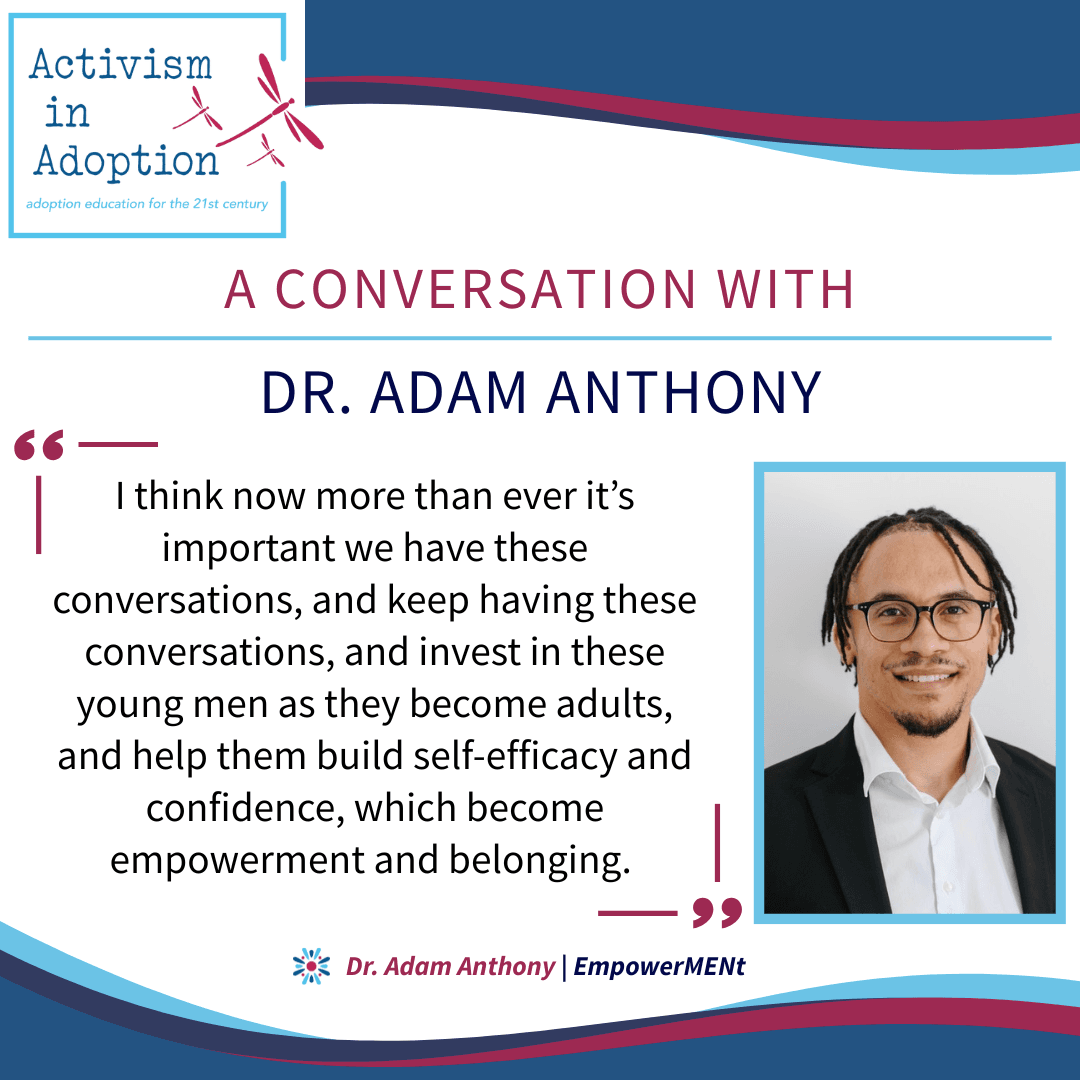
We are honored to have the opportunity to bring Dr. Adam Anthony to Activism in Adoption in February 2026. Dr. Anthony is an educator, speaker, and leadership development strategist whose work centers on identity, belonging, and healing-centered growth. As an adoptee and former foster care youth, he brings lived experience and evidence-informed insight to support individuals and communities in resilience, purpose, and self-discovery. He holds a Doctor of Education in Leadership and a Master of Science in Organizational Leadership from Trevecca Nazarene University, as well as a Bachelor of Science in Communications from the University of Evansville. Dr. Anthony’s professional experience spans educational, faith-based, and nonprofit settings, where he passionately partners with leaders and organizations to see, heal, and lead young men with foster care/adoption experiences on a deeper level. Dr. Anthony is the founder of EmpowerMENt, a platform dedicated to equipping young Black men with tools for emotional wellness, personal development, and leadership. An Eagle Scout, and the Education Chair for L.O.V.E Academy in Nashville, he is committed to service, mentorship, and lifelong growth.
We cannot wait to hear more about what you are doing. Tell us more about your work.
When I think about the work that I do, a lot of it is educating people based on lived adoption experience, yes, but also going deeper—uncovering how nuanced, layered, and complex the system is that produces adopted people, and how hard that system can be for adopted people to navigate. It’s about uncovering what truth means when it comes to origins. In my own journey, through looking at my adoption records and researching social work and court systems, there are just so many layers; so many directions in which to go. I want to see more education centered on how critical lived experience is, and how critical it is for people to understand how complicated adoption is for us. Even the smallest bits of information that non-adopted people take for granted—like what hospital you were born in—we just don’t always have. And when we do have information, we cannot always verify it. We don’t know if we were really born at the hospital we were told we were born at, and we don’t always know if we were born to the person we were told was our biological mother.
When you question these things, it can sound paranoid or like you’re creating conspiracy theories, but when you’ve gone so long without your own information, even when you start to acquire pieces of it, you must challenge what you learn, question it, and try to figure out the truth with additional resources that can confirm what you are learning about yourself. I appreciate it so much now when I see organizations use language like “families of origin” when talking about adoption, because it communicates a deeper truth.
We try to, but the language we use is also dictated by the search terms parents who have placed a child for adoption might use when trying to find support, and that language is what they learned from adoption agencies: birthmother, birthparent, etc.
I use that language too, and then I read an audience comment during one of your recent webinars about why terms like "birth family" or "bio family" can be problematic at times. I didn’t think much about it before, but when I read that, I considered the impact surrounding the language we use, because it adds a deeper level of understanding. When adopted people contend with questions like where did I come from? and how did I come into this situation? they are not just thinking about the biological aspect, or physical aspect, but about things like, what starts a family? What starts a home? What was I born into, first? Those are all questions of origin, and that is where it all starts. I only started this journey, discovering my origins, six years ago. Most of my childhood and into young adult life, I didn't have any of this. I had a little bit of a backstory, but when I look at the records, I see decisions, and amendments, and requests, and filings, and it tells me what steps were taken, what kinds of conversations, mindsets, thoughts, and feelings were involved with the people who were responsible for creating this adoption. All of that matters. It matters so much.
Do you have access to all of your adoption records? That’s pretty rare.
Yes. I filed for them in the middle of the pandemic. I remember thinking, I'm in a place where I'm an adult, and I'm capable of doing this. I really wanted to see what I could find out and take my own story back. I filed, and I had a case manager who worked from start to finish on it, and she was phenomenal, because I had a lot of questions and concerns, but with her help, I ended up with a pretty good chunk of the original paperwork. Before that, all I really knew was that I couldn’t be cared for, for some reason or another, and nobody else was looking for me or wanting me, or stepping up to say, we're not just going to let that baby go into the system.
I was born in the 90s in Tennessee, and things have changed since then in terms of record-keeping. I looked at some of my files, and people were just handwriting things down in a kind of informal shorthand that looks like chicken scratch, and I can’t decipher what it means, but, sure, I guess that’s legal. I guess that’s official. It has made me passionate about the current fight in California and Virginia for adopted people to be able to access their original birth certificates. I want people to be empowered, if they can, to go through the process of uncovering their origins, to take what I have learned, and use it to help themselves navigate the process. To be a resource for them.
What was the catalyst for starting EmpowerMENt?
I started my doctoral journey back in 2022, and I've always been deeply connected to mentorship and advocacy for Black men and boys in general, because I'm an Eagle Scout. I've had 20 years of Boy Scout experience. That’s where it all started. I remember taking a merit badge course on Genealogy back then and falling in love with learning the process and possible pathways for discovering one’s ancestry. Yet I lived with the quiet challenge of my own origins with such a limited backstory. When I started my doctoral journey, I was at a predominantly white institution (PWI), my third PWI academic experience, and a common thread through my educational journey was not having strong mentorship, community, or affirming support. I am a self-starter; if I don’t have something, I create it. But a lot of people aren’t like that. They are highly intelligent, have a lot of capacity and skill in other areas, but they aren’t always interested in networking or know how to access and employ the resources they need.
What I discovered through my dissertation was that Black male students at Historically Black Colleges and Universities (HBCUs) often perceived mentorship programs as extensions of existing community support, while at PWIs, many felt that mentorship programs were inconsistent and less attuned to their cultural and identity needs. Identity—affirming and culturally responsive mentorship—directly impacted confidence, engagement, and the students’ sense of belonging. That insight deeply informs how I view mentorship and advocacy for Black male adoptees, ensuring that both identity and developmental needs can be met.
I noticed as well that at the PWIs I was attending, the advertising for student services and support was skewed towards white, traditional students, most of whom were already well-equipped. That inspired me to write a dissertation comparing the efficacy of mentorship programs for Black male college students who attend PWIs with those at HBCUs, because so many of my friends at HBCUs were telling me they don’t even need formal mentoring programs because they are already part of a culture and system that identifies them, affirms them, and supports their needs.
After I finished my dissertation, it was suggested to me that I build a pilot mentorship program for Black male college students that focused on identity, career planning, and academic performance. I was thinking of creating a model of peer-to-peer networks that brought together men from HBCUs with their peers at PWIs, but then I thought about it through the lens of adoption, because of my own lived experience as a Black male adopted person, and a same-race adopted person, and I started to connect with different adoptive parents and mental health professionals who kept asking me, do you have a group for this? Do you know of a group for this? Adoptive parents were asking me, do you have resources for us, parenting a Black son, because I don’t have this lived experience, and I have tried different mentorship programs for him, and other types of things, but there just isn’t anything out there that fits their unique set of experiences and I cannot connect with him on that level. I get it. I didn’t have that, either. So, I thought, You know what? Maybe I can expand on this. I can build a framework that speaks to the core issues that I’ve seen for Black male adoptees, which include invisibility. That became the groundwork for the They Are Not Invisible Framework.
Can you explain the They Are Not Invisible Framework?
I grew up in a very stable, loving adoptive family environment, and I still felt invisible in some ways, like there was a lack of depth in my relationships with my family when it came to their understanding of my adoption and understanding how that adoption impacted my life. I also didn’t know how to communicate those needs either. It is easier for families or friends to say to adoptees that if they [adoptees] asked for what they needed, maybe they could have helped. However, with a limited backstory of origin, no biological connections present, and the challenging identity frameworks, that reality did not exist. I was invisible in my adoption identity to them, because I was their son, even though I was the son they cared for and raised, and even though they affirmed other parts of my identity, like masculinity and race.
That lack of depth led me to create a framework that explores potential challenges and areas that go unmet for adopted boys like me, especially for those that are being raised in good, stable, loving families. Because their surroundings and environment look good on paper, there's often no deeper investigation into other potential needs that the child may have or what they might benefit from to help them navigate their adoption journey. Often in adoption, if a child isn’t in a deficit space, or if they are well provided for, nobody is looking any deeper, and how adoption may be impacting them remains invisible, so I created a framework to unpack that, and help guide parents, educators, and mental health professionals work with adopted boys and how to approach conversations with them, or find them the resources they may need to affirm that aspect of their identity.
I'm building a set of resources for adoptive parents and their Black sons, who need to know that they are not invisible, that there is a community of men (like me), whose lived experience and mentorship can give them the support necessary to navigate college and life successfully. Men need that: someone they can talk to, connect with, while still in their collegiate experience, who understands where they are coming from.
So much of the education adoptive parents receive about raising adoptive children happens prior to an adoption taking place. It’s all very theoretical at that point. There just doesn’t seem to be many resources available for adoptive parents of teenagers, or young adults, or what adopted people might need as they head off to college.
I am leaning into the coaching aspect because that transition, from late teens heading into adulthood, is so pivotal, because they must learn how to build themselves a secure base away from home, and so much of that is rooted in identity. I remember that. I remember it like it was yesterday, figuring out identity, and how it impacts relationships, career, and how to navigate life’s challenges and complexities. I think there's a better chance of successfully navigating all that if you have someone who can help with it, whose lived experience makes them a good mentor or coach. Obviously, nobody can check every box, but the core thread of being a Black male adopted person navigating challenging spaces? I get it. I’ve walked it, and I want to see other men be confident enough in their identity to go after what they really want; to not hesitate or be tentative.
That hesitancy, that is a normal response, and that can be addressed in mentoring. I grew up in a family that really embraced diversity: mission trips, and my mom being very proactive about introducing us to different cultures, and my dad is from Sierra Leone, so I witnessed the early understanding of how to integrate identities into new and challenging spaces. Learning how to do that means leaning into grounding yourself and recognizing what you bring to those spaces. It’s easy to get into that headspace of feeling like you aren’t enough to be there. That what you bring isn’t enough. But those spaces, they need us. We make the spaces we inhabit better just by showing up, and we need to mentor our young men to believe that and embody that belief.
Going to college, being a freshman, it’s a lot to navigate for everyone, because they are figuring out who they are trying to be, and then when you add on the factor of being adopted, and another factor for being male, and then another factor for being Black, it can be overwhelming yes, but there is an opportunity to empower those identities. I think now more than ever it’s important we have these conversations, and keep having these conversations, and invest in these young men as they become adults, and help them build self-efficacy and confidence, which become empowerment and belonging.
As part of your work, you talk about how belonging isn’t a placement, it’s a practice. Can you tell us what that means?
Belonging isn’t just a solution that is handed to us—here you go, and now you feel like you truly belong and are getting what you need, and that’s it. That’s transactional. Belonging is a consistent practice, where my investment in something and your investment in me are continual. It’s continual through how we show up, what takes place, and what happens afterward. In mentorship, when I work with someone, and we hit it off and really connect, that’s great. That’s a great point of belonging and connection, but after that, I challenge them: when you go off to college, and I am not there, what about our previous interactions that will help you find spaces of belonging for yourself? What are you learning while we work together that will help you discern what it is you want and don’t want? What feels good, and what feels like the kind of connectedness and belonging you want? How are you creating it? How are you finding that for yourself? To create belonging, we must be consistently and continually thinking about how we engage with each other, and to see it as something we create with each other.
That’s a fascinating way to look at belonging, because if it is a practice, then it has to be something we are all practicing, not something created and handed to us.
Back when I was in Scouting, our adult leaders really encouraged us to have a sense of agency in how we navigated the world, how we operate, and how we work with other people. I think that is where I was first introduced to the power of self, in terms of how we can create belonging, not just for ourselves, but with other people. And once you have experienced those kinds of spaces, how are you going to embody everything you gained from them as you move to the next space? We don’t invest in transactional experiences; we invest in connected ones, and connection is something we practice that leads to an outcome of belonging.
Given the work you are doing, what advice would you have for parents raising young Black men who were adopted, given that most of the education they received was aimed at parenting much younger children?
I'm going to reference my framework and remind parents that their child’s adoption journey should not be invisible. There's a double invisibility that male adoptees experience when it comes to their adoption and when it comes to their understanding of masculinity. My advice is we must look deeper when it comes to how we're raising and supporting male adoptees, not just in terms of the basic needs—shelter, food, clothing—but also the mental and emotional needs they may have, and how that connects to their identity. I think parents should be curious about their child’s needs, not because you think there is something wrong you must fix, but to be more curious about who your boy is, and what their thoughts and feelings? I promise you, there are depths there that they may not be showing, and your curiosity can be a bid for connection that they need. I think as a parent, it's also your responsibility to encourage them to still be affirmed with the knowledge and the trust that this isn’t a one-and-done conversation, and remind them that if they want to come back and talk about this again, or have more questions or follow up, you are here for them. It doesn’t matter when, it doesn't matter how; but try to say something as simple as, we have the space to do this, okay? I'm not going to pressure you; I'm just going to make sure this space exists for you.
This month we are waiving all fees to register for Dr. Anthony’s upcoming webinar with Activism in Adoption, “They Are Not Invisible: Centering Adopted Boys’ Identity, Belonging, and Support," happening on February 25th, 2026. This session centers adopted boys and examines how their identity, emotional, and belonging needs often remain unseen when adoption is framed primarily as a successful placement. Drawing from his lived experience and research insights from his doctoral work, he introduces the They Are Not Invisible framework to highlight common gaps in support. Participants will gain practical insight into how families, educators, and professionals can move beyond good intentions toward more intentional, identity-affirming care.
To learn more about Dr. Anthony’s work, or to connect with him directly, visit the EmpowerMENt website, or find him on Instagram, Facebook, or LinkedIn. You can also connect with him directly via email. You can also find him giving a talk entitled, Reframing Belonging: Identity, Story, and Wellness for Black Male Students and Educators, at The BOND Academy 2026 conference on April 25th, in Baltimore, MD.